Essay on the Editing of ‘The Great Gatsby’

gatsbycover1The excellent literary blog called The Elegant Variations has a 4-part post that reprints an essay by Susan Bell about F. Scott Fitzgerald’s revisions to The Great Gatsby through his close work with editor Max Perkins.  Bell discusses the absolutely crystal sharp writing in Gatsby that was the result of meticulous rewrites from Fitzgerald and a strong editorial viewpoint from Perkins that the author was more than willing to acknowledge after publication.

Critical reaction at the time of the novel’s publication noted its incredibly polished writing:

For H. L. Mencken, the novel had “a careful and brilliant finish. . . . There is evidence in every line of hard and intelligent effort. . . . The author wrote, tore up, rewrote, tore up again. There are pages so artfully contrived that one can no more imagine improvising them than one can imagine improvising a fugue.

Here’s another quote from Bell’s essay:

In autumn 1924, Fitzgerald sent Perkins the Gatsby manuscript. The editor diagnosed its kinks, then wrote a letter of lavish praise and unabashed criticism. “And as for the sheer writing, it is astonishing,” wrote Perkins. “The amount of meaning you get into a sentence, the dimensions and intensity of the impression you make a paragraph carry are most extraordinary.” A crucial problem, though, was the hero’s palpability. Perkins explained:

Among a set of characters marvelously palpable and vital—I would know Tom Buchanan if I met him on the street and would avoid him—Gatsby is somewhat vague. The reader’s eyes can never quite focus upon him, his outlines are dim. Now everything about Gatsby is more or less a mystery, i.e. more or less vague, and this may be somewhat of an artistic intention, but I think it is mistaken.
George Orwell’s Quest for Truthful Language

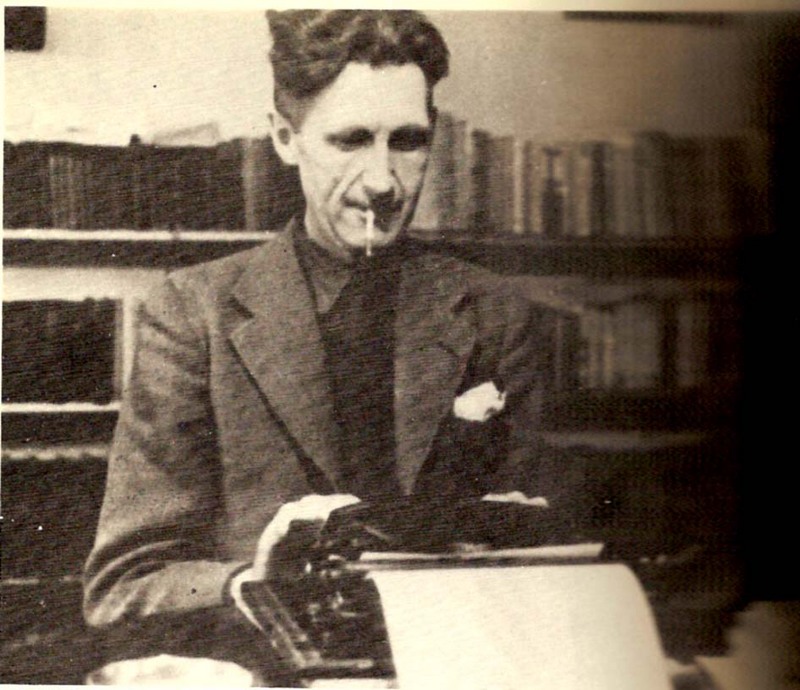
New Statesman has a very interesting article by Keith Gessen about George Orwell’s ‘plain spoken’ style that manifested itself in a series of essays in the 1940s and found its full expression in his masterwork, Nineteen Eighty-Four. It’s fascinating to read about how Orwell’s experiences with fighting in Spain during the civil war in the 1930s and journalistic coverage of the events of that war influenced his use of altered and entirely untrustworthy newspaper articles in Nineteen Eighty-Four.  Orwell apparently believed in clear, sharp and truthful language.  He did not want ready phrases or dead metaphors.  He wanted keen observation and simple expression.

I think he achieved this in Nineteen Eighty-Four to a great degree.  Mr. Gessen says one thing in his article that I don’t necessarily agree with: “In truth, Orwell was wrong about all sorts of things, not least the inner logic of totalitarianism: he thought a mature totalitarian system would so deform its citizenry that they would not be able to overthrow it. This was the nightmare vision of Nineteen Eighty-Four. In fact, as it turned out in Russia, even the ruling elite was not willing to maintain mature totalitarianism after Stalin’s death.”

I don’t think that’s quite right.  The totalitarian regime in Nineteen Eighty-Four is overthrown.  In the last section of the book the writing jumps out into the future and discusses a quite obviously defunct and long-gone totalitarian state that tried to reduce language to its own ends.  I think the point of Nineteen Eighty-Four is that complete control of a population can be largely achieved with various mind-control techniques and the constant application of fear, but that it requires only a modest intelligence to resist and eventually overthrow such control.  The novel’s protagonist, Winston Smith, is just an ordinary schlump.  He’s not very bright.  Pretty dim in fact.  The idea with Winston Smith is if he can do it then anyone can.  And yet he is capable of resisting until his will is ultimately beaten out of him.  But the point is that the will to resist is a real pest.  You can’t remove it from society.  It always comes up and eventually overpowers all control structures.

Purchase Nineteen Eighty-Four

Japanese Toilet Paper Horror

Lucky Koji Suzuki is the Japanese author of a 9-chapter novella to be printed on toilet paper rolls.  The story takes up approximately 3 feet of toilet paper and allows readers to enjoy their fill of horror from the comfort of their toilets which may in fact turn out to be the best place for them to be in case the little story scares the **** out of them.  But what happens if you’re in the middle of the story and you stop and then a friend comes over and uses up a couple of chapters?  Also, how do you bookmark your place?  Or do you even have to?  I might buy this for a Halloween joke.  But then all my party guests might spend the entire evening in the bathroom which would be pretty weird.

Green Lantern in Absurd Fan-Film Trailer

Jaron Pitts has made a movie trailer for a non-existent Green Lantern superhero movie.  Quite frankly, it’s an odd thing to do and I don’t honestly know why anyone would do it.  I certainly like the way it looks for the most part.  I’ve always liked the idea of the Green Lantern.  But a fan film trailer?  I don’t know.   There’s a mashup of various films going on in here with some effects on top. The main problem with this kind of work is that you take popular and well-understood tropes from Hollywood super-hero action movies and reproduce them with sometimes astounding faithfulness, but what you end up with is a photocopy of current filmmaking habits.  It’s like jumping up and down shouting, “Look!  I can do it!  I can make the ship, you know… like fly just like in the big Hollywood pictures!  Like, you know, it zooms in at you and then it stops, and dips its wings and then darts off in another direction with a big ‘WOOSH’ and a little burst of energy and then the music goes ‘CRASH’ and then we see the guy in the pilot’s seat…”  and so on and so on.  My Green Lantern trailer would just have a tired nut-job sitting at his dining room table with a flashlight and a roll of Scotchtape, trying to fashion himself a green light logo to stick on his chest while he poses in front of a full-length mirror.  But that’s just me.  I would generally advise skilled and talented filmmakers to avoid wasting their time.

Animation: Café Serré

A cop sits in a diner having his simple breakfast and, without so much as breaking a sweat, he foils a robbery.  Café Serré is a short animation by Denis Bouyer for Supinfocom Arles.  I love the way the cop reaches for his coffee spoon and misses it the first time.  Great detail.  Nice timing.  Fabulous diner too.

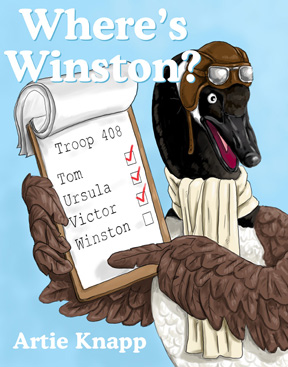
Storybook: Where’s Winston?

by Artie Knapp (USA)
the author has an excellent story site: artieknapp.com
illustration by Emily Doyle (emilydoyledesign.com)

whereswinston

The cold wind blew past the geese with the weight of a freight train and the sting of a hundred bumble bees. It was a strong reminder of why they were migrating south for the winter. As the geese did their final stretches in preparation for the long flight that lay ahead, Ralph, the flock’s flight commander, proceeded to do a final roll call.

Continue reading

Podcast Novel: Pirate Jack (Chapter 2)

DOWNLOAD MP3 AUDIO

This book contains pirate battles, violence and death. Please use your judgment before playing for very young children.

Here’s a free podcast of our fantastic pirate adventure novel written for young readers. It’s got hidden scrolls, time travel, ships, battles, navigation, gold, islands, jungles and helicopters in it.

You can purchase the high-quality paperback from Amazon for $11.95 or just $1.99 for a Kindle e-book version.

Or you can purchase the paperback from Barnes & Noble (Price: $11.95)

Description:
Young Jack Spencer sees his father’s boat-building business destroyed by a powerful land developer. Then Jack unearths three ancient scrolls that propel him on a dangerous adventure through time in search of a pirate treasure.

When Jack finds himself aboard the pirate ship Revenge with Captain Jameson’s crew, he enters a life or death world of ship battles, jungle islands, prison escapes, gold, and treachery.

Set during the golden age of Caribbean piracy, Pirate Jack combines rollicking adventure with the moving story of a boy’s love for his father and a courageous effort to save a way of life.

You’ll find regular podcasts of all the chapters over the next couple of months. Subscribe to our feed.

This book is read by the author.

All audio stories are Copyright © Candlelight Stories, Inc., All Rights Reserved.

Book Trade Woes Mean Change

holmesbookThe Nation has a fascinating essay by Elisabeth Sifton called The Long Goodbye? The Book Business and its Woes.  She writes about the tidal changes facing the entire book industry from publisher to bookseller to reader.  Here’s a short excerpt:

“Books have had a kind of spooky power, embedded as they are in the very structures of learning, commerce and culture by which we have absorbed, stored and transmitted information, opinion, art and wisdom. No wonder, then, that the book business, although a very small part of the American economy, has attracted disproportionate attention.

But does it still merit this attention? Do books still have their power? Over the past twenty years, as we’ve thrown ourselves eagerly into a joy ride on the Information Superhighway, we’ve been learning to read, and been reading, differently; and books aren’t necessarily where we start or end our education. The unprofitable chaos of the book business today indicates, among other things, that slow, almost invisible transformations as well as rapid helter-skelter ones have wrecked old reading habits (bad and good) and created new ones (ditto). In the cacophony of modern American commerce, we hear incoherent squeals of dying life-forms along with the triumphant braying and twittering of new human expression.”

The image is of Sherlock Holmes disguised as an old bookseller in the film, Sherlock Holmes and the Secret Weapon.

California Supreme Court Legalizes Bigotry

The California Supreme Court has upheld a recent statewide vote that amended the state constitution to define marriage as only between a man and a woman.  This is the same court that only months ago ruled that any ban on gay marriage was a violation of rights.  Their recent ruling, however, focuses on the legality of the vote to amend the constitution to rule out the possibility of same sex marriage.  If it is legal for voters to take away the right for gay people to marry by passing a constitutional amendment, then it would be just as legal for those voters to amend the constitution to say that marriage is only between a white man and a white woman.  That’s what California’s Supreme Court has ruled in all its wisdom.  They have legalized rampant bigotry.

Continue reading

Fiction, Computer Games and Dante’s Inferno

Here’s an article by Tim Martin in The Telegraph about how computer games are having a growing influence on literature.  As the game’s trailer shows, the upcoming computer game, Dante’s Inferno, will be a wild ride into hell.  I’m sure the game is full of levels as most games are and as Dante’s original literary Inferno certainly is.  It will also most likely contain a good sampling of quotations from the original since you’ve got two poets running around in hell making observations and explaining things for all of us.  In the electronic version I’m sure that Dante will get to cut off many limbs and heads and such things.  I don’t know – is gaming influencing literature or the other way around?  Maybe a little.  I think gaming is having more of an effect on film making.  Maybe the answer is in the trailer.  I also think that if you are going to make a game based on Inferno, you should not make it an action game.  You should make it an open-ended exploration of hell.  Just that.  No more required.

Where Do Fairy Tales Come From?

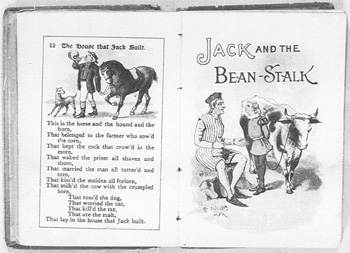
The traditional notion of where fairy tales come from suggests that people like the Brothers Grimm listened to oral folktales handed down through the generations and wrote them down with little embellishments.  But now, in a book called Fairy Tales: A New History, Ruth B. Bottigheimer argues that fairy tales have a much more literary genesis than has been commonly thought.  The Chronical Review has an interesting article about the different theories on the origin of some of the world’s most retold stories.  The article points out how confusing and complex the history of fairy tales becomes when you consider that many of the most familiar tales are shared across different cultures.  Jack Zipes, a leading translator and adapter of fairy tales says that “It’s absurd to create a dichotomy. The literary and the oral thrive off one another.”

Purchase Fairy Tales: A New History (Excelsior Editions)

Film: I Dreamt of Flying

Filmmaker Alex Bland made this animated/live action film about RAF bomber squadrons during World War II.  He mixes hand-drawn illustration and archive footage from the war.  The soundtrack is excellent.  I really like how the film explodes into abstraction as the planes fly through the spotlights during an attack.  Mr. Bland also made an excellent animation called Unforgettable Evil From Mars.

French Navy: Video from Camera Obscura

This video is from the album My Maudlin Career, by Camera Obscura.  The song is good and bears repeated listens.  The video is sort of an homage to films about love, or about couples anyway.  There’s a little French New Wave in it.  A little Fellini too.  It works.  We should all dance down the sidewalks and jump over things and climb lampposts when we’re out on dates, shouldn’t we?

President Obama Moves Toward Fascist Ideas

Watch liberal MSNBC commentator Rachel Maddow in this video.  Watch the whole thing.  She’s leading us through what may amount to the most terrifying fascist speech ever delivered to the people of the United States.  The sitting president is moving toward setting up a legal structure that will place people in ‘prolonged detention’ BEFORE they have committed any crime or have even been charged with a crime if they are determined to be a possible danger to the United States.  Maddow points out how this is the exact premise of the science fiction film Minority Report which was based upon a Philip K. Dick story.  This is a well-known liberal commentator who says at the end of the video that this Obama speech is ‘one of the most radical proposals for defying the Constitution that we have ever heard made to the American people.’

The American Civil Liberties Union has responded with short statement.

The bottom line is that this president is shocking human rights and civil liberties organizations all over the world with his rapid move toward fascism.  These are largely liberal organizations that once looked upon Mr. Obama as a welcome change from eight years of assaults on civil liberties.  They and many liberal voters in the United States are profoundly disappointed and legitimately horrified at what they are hearing from this president.

So, if you write or say something that makes someone somewhere in the Obama administration decide that you might be some sort of danger in the future, you could be arrested and held in a new separate legal structure that could keep you imprisoned indefinitely – forever.

That is a profoundly un-American and illegal idea.