Here’s a repost of a little Christmas film I made last year.
Category Archives: Film
A Trip to Mars: 1910 Science Fiction Film Produced by Thomas Edison
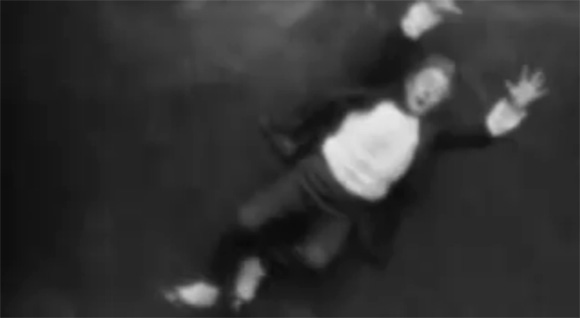
This is 1910 kinetoscope by Thomas Edison that is thought be perhaps the first American science fiction movie. A professor makes a ‘reverse gravity’ powder and takes a trip to Mars where he encounters a giant creature. Silly, but charming and with pretty decent visual effects.
Detective City Angel: A Film by Alessandro Cima
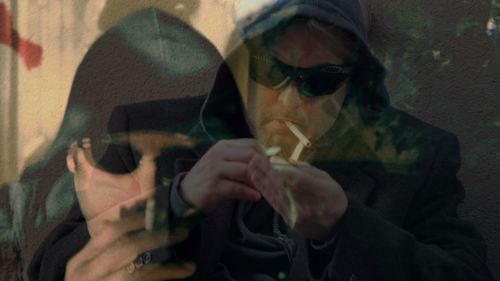 This is a Los Angeles crime film. But it’s as if several films on celluloid fused together and what you end up with is an art film that gets overwhelmed by urban documentary and then collapses into a narrative thriller. It’s filled with hints, clues, evidence and misdirection. Images, ideas and sounds bounce off each other, mirror each other. There are secrets in this film. You have to watch carefully, through layers to catch things. I’ve tried to make a film that moves like disjointed thoughts toward the preordained ending. Continue reading
Aleph: California Beat Artist Wallace Berman’s Only Film
While I was running through the Getty Center’s flagship portion of the massive citywide ‘Pacific Standard Time‘ art exhibit, I was struck by just how great this Wallace Berman fellow really was. Known primarily as the ‘father’ of assemblage art, he was also a member of the Beat Movement. He made a single film which occupied much of his time through the 1960s and 70s. It’s less than eight minutes long and it’s a drop dead gorgeous thing to see. He’s one of those film artists interested in what I like to call the messy image. The film seems to have been dragged through ink and dirt. It’s been scratched, wrinkled, folded, cut, slashed and stained. Letters flash by like subliminal messages. Pop culture crashes into modern art. He films magazines, papers, radios, faces, hands, rock stars, body parts, buildings, streets and apparently just about everything he had lying around in his studio. This film is a quiet little reminder that crystal clear HD and super sharp focus are not anywhere near the concerns of some artists.
And here is California assemblage artist George Herms talking about Berman recently as part of the Pacific Standard Time series of exhibits:
Attempt: A Short Film by Jennifer Sharpe
The film seems almost out of time. It could have been filmed fifty years ago. The gently swaying palms of Los Angeles fit between buildings easily but seem to have a romantic life in this film. The music, a piece for theremin and string quartet by Herbert A. Deutsch, fits the imagery in Jennifer Sharpe’s film to perfection. This kind of filmmaking, done with a small camera and then edited and colored in a relatively simple digital editor, is very close to the simplicity of the poet working in a notepad or the artist sketching from her window. Sharpe’s films are deeply felt poetic expressions that seem to exist in the only possible form that they could have. She turns her video images into something close to painting, extending time and finding mystery in simple movements. She has a very gentle approach but with strength in her observation and emotional ability, sort of like a butterfly with steel wings.
You can find out more about Jennifer Sharpe’s digital videos and paintings at her web site.
Girls: A Violent and Gorgeous Film by Maureen O’Connell
This film’s writer and director, Maureen O’Connell, is a student at the Royal Academy of Dramatic Art in London. The school doesn’t make a good first impression with all its diction and dialects. But her film does. I’m a bit of a jerk about British drama training. Derek Jacobi once made an offer of employment that I refused while asked for another beer. That’s my general attitude about the Kenneth Branagh tribe. Nobody’s ever produced duller Shakespeare than Mr. I-Am-a-Hard-Working-Shakespearean-Dammit! O’Connell comes from Ireland… usually an ace up an actor’s sleeve… except in Mr. Branagh’s case. If O’Connell can keep RADA off of her back, she might just have something very fine going on as a director. She’s made a great film here. There are some technical issues with sound that annoy me, but they seem easily solvable by simply converting a stereo track to mono and blending a few audio transitions together. Someone could fix that up in a few minutes for her.
The film is about a comfortably middle-class girl who seems disconnected from her family and friends. She takes a sudden turn toward what I can only call suburban violence. The film builds quietly toward a surprising viciousness that seems very real. O’Connell darts around the action like she’s making a documentary. She works well with actors, somehow getting large groups of them to create scenes that are shockingly realistic and disturbing. There’s not a hint of awkwardness in her camera work. In fact, she seems, along with director of photography Arthur Mulhern, to revel in what I call the messy image. It is my belief that only people who seek out messy images can become great filmmakers. I will not explain that too much. It should be obvious to any filmmaker. The film contains a crystallizing and gorgeous image where O’Connell points the camera into the sun and tracks a running group of teenagers after a fight. It’s a great image that violates the norms of video photography. In fact, I notice quite a bit of light leaking into the lens during the film. O’Connell’s violence is shocking but also mesmerizing. She approaches it in a slightly off-kilter manner that I can’t quite get a handle on. Just when you think it’s time for her to calm down and quiet things, someone gets kicked in the face. She just has a natural sense of drama.
Her lead performer, Marilyn Bane, conveys her role brilliantly. She is a cross between likeable innocence and brute savage that I want to hit with a baseball bat. Really fine work. All the actors are terrific and the group of ass-kicking girls is just horrifying.
So this Maureen O’Connell is probably going to be making something very fine for the BBC soon. Get ready for it. Because it won’t be pretty. But it’ll leave a big bruise for a long while. She’ll most likely have to get over all that RADA stuff. Although, to contradict myself slightly, she does do this nice little Romeo & Juliet thing that I listened to!
Traumatografo: Magnificent and Mysterious 1975 Film by Paolo Gioli
I did not know this filmmaker, Paolo Gioli, existed until yesterday. And that really bothers me because I feel a very strong kinship with this filmmaker just on the basis of having seen two of his pieces. What can a filmmaker do with his own backyard? That is the question that comes to my mind as I watch his films. Can a filmmaker take his camera out back and make something astounding? Of course. In fact, that skill is central to being a creative filmmaker. It is the feeling I get from Gioli. He makes films that have a guiding concern but he is not afraid to slip a little off of the main track and let you see him experimenting. One can observe his enthusiasm for a new mechanical technique and he allows his film to wander into the territory of the new machine or splicing method for a while. And then he comes back to the main thing. He never lets this get out of control and it is a miracle to watch. One can learn how to experiment by watching a brilliant experimentalist. It’s that simple.
There are many filmmakers I wish I could meet and perhaps work with. Gioli is one of them. In fact, this brings to mind again my thought that things like YouTube are the greatest cinematic development of the past half century. The reason has nothing to do with screen format or size or image quality. It has to do with intimacy. The feeling of connection one can get by watching a filmmaker’s work on the computer is far more intimate than could be achieved in a theater. It is this quality that is the most important contribution of online film to world cinema. Intimate connection to the artist. It has a powerful effect on artists and communicates ideas and inspiration from generation to generation far more effectively than any prior cinematic display technology.
Here is a nice long article by Bart Testa about this wonderful Italian filmmaker.
Here is an article by David Bordwell on how Gioli’s hand-made cameras influence his ‘vertical cinema’ technique.
Robert Frank Film of The Rolling Stones
It’s all very confused and mysterious. In 1972, the Rolling Stones hired photographer and filmmaker Robert Frank to make a film about their American tour. He made something wonderful called ‘Cocksucker Blues,’ which immediately angered the Stones because it actually showed them to be the ultra coolest and baddest band in the world. They sued him to keep the film out of circulation. Go figure. Why would you sue a guy for making the one absolute piece of evidence that you are what you say you are: ‘The greatest rock & roll band in the world?’ Well I don’t know the answer. Drugs and addled minds perhaps. This short film is actual footage taken by Frank on Super 8 cameras. It’s been edited by someone called Videodrumz on YouTube and put together with ‘Rocks Off’ from the ‘Exile on Main Street’ album. It’s good. It works. The footage is absolutely recognizable as Frank’s.
The Dystopian Trilogy: A Film by James Schneider
James Schneider made ‘The Dystopian Trilogy’ in 1993, mainly through the use of found footage. Its three parts, ‘Faerie-Monition,’ ‘Oasis,’ and ‘Median Strip,’ convey modern Americans’ infatuation with closing off entire communities from the rest of the world for some theoretical benefit. The first part deals with the corporatization and homogenization of imagination through eerie footage of Euro-Disney. The second part focuses on a gated community near Las Vegas. The third contrasts and connects the freedom of the modern highway to the growth of our prison system and the fast-growing outrage of private prisons run for profit. This last part, when seen in light of today’s use of immigration law to fill corporate-owned prisons with people who are turned into a slave workforce, is particularly frightening.
Cuadecuc, Vampir: 1970 Spanish Underground Dracula Film Shot as Attack on General Franco
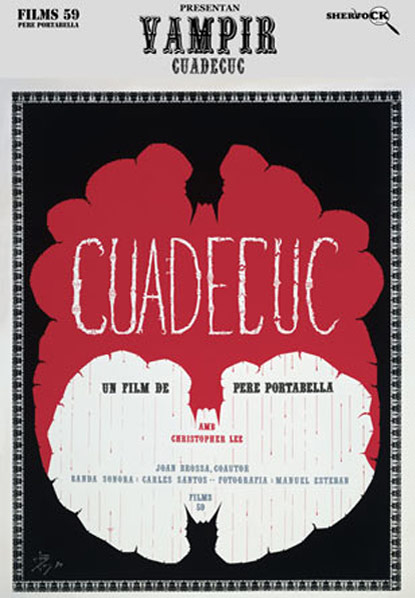 Here’s an extremely rare underground Halloween treat for anyone who loves film. Ah, but only the very fewest of you will actually watch this all the way through! Give it a try. Not only is this film underground… it’s underhanded. Pere Portabella made ‘Cuadecuc, Vampir’ in 1970 by filming on the set of a Christopher Lee film called ‘Count Dracula’ that was being directed by Jesus Franco. Portabella’s underground classic is on its surface a silent horror film. But it’s also a documentary about the making of the Dracula film. It tells its story by stealing scenes from the feature being shot around it, almost as if the film were a mashup of existing footage! The high-contrast black and white photography evokes such cinema greats as Carl Theodor Dreyer’s ‘Vampyr’ and F.W. Murnau’s ‘Nosferatu.’ We see typical horror scenes like a stagecoach racing through the wilderness, or a dusty crypt, interrupted by the arm of a prop person using a fan to blow fake spiderwebs or a cameraman shooting from behind furniture. These slippages from horror into documentary actually produce a weird terror when you realize that the film was being shot under the watchful eyes of Spain’s dictator, General Francisco Franco. What the film really is underneath all the fantastic and disturbing imagery is a vicious attack on Franco and the false media manipulation that keeps all dictators in power. The portrait it paints of Franco himself is one of a sad, disturbed and largely ineffective vampire who lives inside a mental construction based on the past. The other characters in the film seem to be wandering through this psychotic realm, trying to find a way out.
The soundtrack incorporates jet engines, muzak, electronic music, opera singing, jackhammers, stuck records and various other electronic sounds. Don’t let this throw you because the soundtrack is one of the most eerie and unsettling that you will ever hear.
And I’m thinking that Criterion needs to jump on this and make a nice blu-ray release out of it.
Pere Portabella has a web site.
Now, just for kicks, here is a scene from the actual color film of Dracula being shot while Pere Portabella stole his own film right under Christopher Lee’s nose! You decide which film seems scarier.
Nova Express: Epic Online Film Adaptation of the William S. Burroughs Novel by Andre Perkowski
Filmmaker Andre Perkowski is working on a huge 3 hour plus adaptation of the novel ‘Nova Express‘ by William S. Burroughs. It’s a wild, ragged, disjointed, warped, damaged, serious and funny mashup of found footage, original film and Burroughs’ reading voice along with others. It’s got those incoherently combined sci-fi and thriller elements that Burroughs so easily manipulated as if in a delirium. The film is itself a kind of cutup, mirroring the technique Burroughs used that involved gathering unrelated bits and pieces of other books and newspaper articles to formulate sentences that somehow ramble on without necessarily leading anywhere specific. The novel is about exposing the secrets of those who attempt to control all thought and life with virus-like ideas, machines and drugs.
Perkowski is a filmic oddball who delights in making things that are messy. He draws and collages to create new images, purposely ruining his images to create the unexpected. I think his mental immersion into Burroughs is leading him through his wonderful film with great assurance. Apparently, Perkowski is constantly adding to the film and changing it. He has at least six different ‘drafts’ of the film. As he goes, he posts chunks of the film on his YouTube channel which I happen to think is a fantastic idea. There are similarities between the way he works and the way I work on films like my ‘Yellow Plastic Raygun.’ I have often told people that I suspect the video scrubber button in non-linear video editors that allows a filmmaker to fly through a full length feature film in seconds is perhaps the single most important cinematic tool of the last thirty years. It is this little tool that allows for the searching and matching of cinematic elements that could never have been found in a human lifetime before the non-linear editor. So it leads to entirely new form of cinema. That’s what you are watching here with Perkowski’s film. It is a powerful work of new cinema and may well be the best adaptation of a Burroughs work that I have ever seen.
Here’s a great interview with the filmmaker that focuses on this film.
Part 2
Parts 3 – 10 after the jump…
Continue reading
La Tentation de Saint Antoine: 1898 Special Effects Film by Georges Méliès
Oh that lucky fellow, Saint Antoine! To find myself in his shoes as he is ‘tormented’ by the temptations popping in and out of his little cave! My oh my! What a lucky guy! This is Georges Méliès experimenting with making people appear and disappear magically.
The Eye Like a Strange Balloon Mounts Toward Infinity: A Film by Guy Maddin
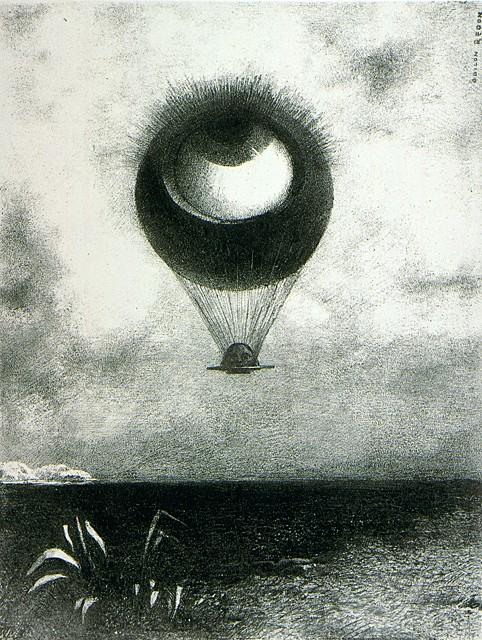
Canadian filmmaker Guy Maddin made this short film which is inspired by an 1882 illustration by Odilon Redon that was in turn inspired by the writing of Edgar Allan Poe. It has a kind of wild sinister fantasy about it that fascinates me. I like the way Maddin builds little sets that end up looking almost like illustrations. He also does a quick visual quote of a great old French film called L’Atalante by Jean Vigo. This is a frightening and beautiful dream film.
Greetings From Los Angeles 1978: Super 8 Film by George Porcari
George Pocari made this film of Los Angeles in 1978. It’s beautiful and it shows the things one sees every day without really noticing. Films like this one turn out to be incredibly valuable glimpses of the past. It’s funny how home movies end up getting closer to art films as they age. But this one actually started off as a kind of art film. It’s very well made.
Send Me to the ‘Lectric Chair: Short Film by Guy Maddin
Canadian filmmaker Guy Maddin made this short in 2009 with Isabella Rossellini in the lead role of a woman who finds ecstasy in an electric chair. The film moves beautifully with its music and entertains with its silent film mystery and accelerated movement. However, I will say that Maddin’s films seem to me overly concerned with silent film technique. This tends to turn the films into curiosities rather than genuine works of art. That’s a tricky area because the films put so much virtuosity on display. But you can hide enormous failures behind that ‘old film look.’ I’m not sure that’s what Maddin is doing, but my suspicions are growing. Maddin might be interested at some point in working with less budget.
Thank you to filmmaker Fred. L’Epée.