Apple About to Announce Extraordinary New Tablet Device

Apple really could be preparing to announce something pretty extraordinary for content publishing, creation and consumption today.  Its widely rumored tablet device will very likely put most other ebook reader devices out of business simply because the Apple product will be a real computer, useful for reading and for creating.  It will most likely build a seamless content-creation universe that ties directly to online sales platforms.  It will be a ‘publishing’ tablet really.  Not just an e-book device.

Wired is covering the Apple press conference event all day with blog entries.

I have not purchased any kind of an e-reader device, in spite of the hysteria surrounding them, specifically because of Apple’s plans.  There is no way under the sun that anyone else is going to compare favorably to what Apple is about to drop on us today.

Poetry Is? It’s a Stupid Question, That’s What.

In my poetic web adventures I went and found this big long movie by George Quasha about poets trying to tell everybody what poetry is. What is poetry? It’s not an unanswerable question. It’s a stupid question. But these poets do try to answer it. It’s a rather long movie and I always look for a bad guy in every movie. Without a bad guy, a movie just makes me hungry and I get up to go to the bathroom a lot. These poets are all so nice and content looking. So friendly and comfortable. I can’t find out which one is the bad one. Someone once asked me a really stupid question and I ran away with his camera and threw it in the river. Why aren’t any of these poets nasty and depressed? What makes them so pleasant? They all sound like their favorite piece of furniture is a podium.

Here’s a guy who if you ask him what poetry is will very likely give you a good reason to never ask that question again:

Get what I mean?

Short Sci-Fi Film From Kenya: Pumzi

Writer/director Wanuri Kahiu has made a twenty-minute science fiction film in Kenya about a future that takes place after great water wars have left the earth barren and lifeless.  The short, called Pumzi, is playing at the Sundance Film Festival.  It was produced by Inspired Minority Pictures.  The film follows a woman who works for a museum in one of the great self-contained indoor cities of Africa.  She finds a single germinating seed and escapes to the dead landscape outside where she wants to plant the seedling.  The film looks beautiful.  I can’t wait to see the whole thing.

Crisis Camps: Computer Techies Helping Response for Haiti

Computer programmers and other technical people are building valuable tools for helping the people of Haiti after the devastating earthquake on January 12. Crisis Camps have been set up for volunteers to develop applications that help with damage assessment, mapping, locating of survivors, locating first aid stations, translation, radio communications, food and water deliveries, free phone services, and many more.  At the root of the effort is the basic understanding that good data must be given to and easily shared between all of the aid organizations, both public and private, helping with aid and rescue in Haiti. Some of the earliest volunteers for Crisis Camp came from Google, NASA, the United Nations, the American Red Cross and the Los Angeles City Fire Department.

Google developed an online tool to help people locate missing persons in Haiti.  The technical effort has a Wiki page at Crisis Commons Wiki, that gathers resources, updates on projects, and calls for volunteers in specific areas.

The Crisis Camp volunteer approach is building something very powerful that will have a huge impact on disaster response in the future.  This is the internet and tech world at its very best.

Podcast Novel: Pirate Jack (Chapter 10)

DOWNLOAD MP3 AUDIO

This book contains pirate battles, violence and death. Please use your judgment before playing for very young children.

Here’s a free podcast of our fantastic pirate adventure novel written for young readers. It’s got hidden scrolls, time travel, ships, battles, navigation, gold, islands, jungles and helicopters in it.

Continue reading

Podcast Novel: Pirate Jack (Chapter 9)

DOWNLOAD MP3 AUDIO

This book contains pirate battles, violence and death. Please use your judgment before playing for very young children.

Here’s a free podcast of our fantastic pirate adventure novel written for young readers. It’s got hidden scrolls, time travel, ships, battles, navigation, gold, islands, jungles and helicopters in it.

Continue reading

Podcast Novel: Pirate Jack (Chapter 8)

DOWNLOAD MP3 AUDIO

This book contains pirate battles, violence and death. Please use your judgment before playing for very young children.

Here’s a free podcast of our fantastic pirate adventure novel written for young readers. It’s got hidden scrolls, time travel, ships, battles, navigation, gold, islands, jungles and helicopters in it.

Continue reading

Podcast Novel: Pirate Jack (Chapter 7)

DOWNLOAD MP3 AUDIO

This book contains pirate battles, violence and death. Please use your judgment before playing for very young children.

Here’s a free podcast of our fantastic pirate adventure novel written for young readers. It’s got hidden scrolls, time travel, ships, battles, navigation, gold, islands, jungles and helicopters in it.

Continue reading

Folktale From Haiti: Wings on Her Feet

adapted by Adam Price (Peace Corps Volunteer, Haiti, 1996–1998)

You can also listen to this story by clicking here.

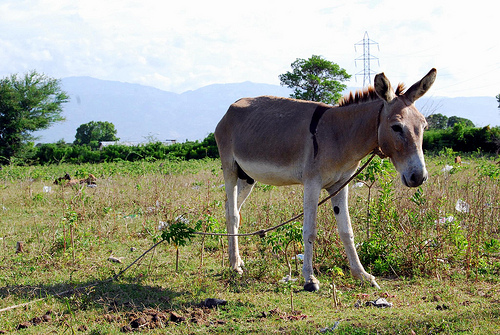
Photo by Garrett Crawford

There once was a gentle little donkey named Zel Nan Pye. Everyone in town would call out, “Hello, Zel!” as she trotted by, and Zel’s long, furry ears would stick straight up at the sound. Although Zel longed to turn her big, brown eyes and reply, Madame Charity, her owner, held her reins too tight.

“Keep moving!” Madame Charity would call out from above her. “I haven’t time for any social calls.”

As much as everyone in town loved Zel, they feared Madame Charity. She was an angry, spiteful old woman who threw stones at birds when they sang and hollered at little girls when they laughed. But to poor Zel, she was the meanest of all.

Every Saturday, Madame Charity loaded Zel down with heavy sacks of rice and sugar that she sold at the market. Although the old woman knew that whoever arrived at the market earliest sold the most, she always woke up late.

Continue reading

Folktale from Haiti: Why Cats and Dogs Never Get Along

adapted by Donalson Latour
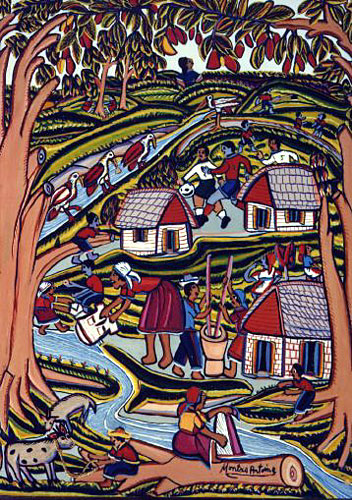
'Children Playing' by Montas Antoine (Port-au-Prince, Haiti) 1960

One day Mr. Cat and Mr. Dog were in a discussion about going to God to ask him a favor. Mr. Cat says he was going to God to ask him “can dead people don’t come back to life,” and Mr. Dog says he was going to ask God “can dead people come back to life.”

So they decided to race each other to see who’s going to get to God first. Mr. Cat was so clever; he puts a bone in every corner that he knows Mr. Dog was going to turn on so he can slow him down. Mr. Dog thought of something smart too but he was not clever enough to trick Mr. Cat, so Mr. Dog puts a bowl of milk in every corner that he knows Mr. Cat was going to turn on so he can slow down.

While Mr. Cat was running he saw the milks but he didn’t pay any attention to them because he knows what Mr. Dog was trying to do. And Mr. Dog was so stupid and greedy, he stopped in every corner to enjoy the bones that Mr. Cat prepared for him but he didn’t know if it was a trick to slow him down.

So then, Mr. Cat reaches God first, when Mr. Cat gets to God he started talking to him and said, “God I don’t want you to bring dead people back to life,” and God said, “Okay no problem.”

Then Mr. Cat went home. When Mr. Dog finally finished enjoying his bones, he went to God and said “God, can dead people come back to life?” and God said, “I’m sorry Mr. Dog, Mr. Cat already came here and told me that he doesn’t want dead people come back to life.”

So, since then, dogs don’t like cats. And every time a cat sees a dog, the cats always trying to approach the dogs friendly but dogs always give them mean look. That’s why cats and dogs never get along.

The End

“Why Cats and Dogs Never Get Along” has a Creative Commons Attribution 3.0 License

Here are some ways to give earthquake assistance to the people of Haiti:

The Red Cross, Doctors Without Borders and the United Nations Food Program are putting medical supplies, doctors, nurses, food and water on the ground in Haiti to try to prevent the worsening catastrophe and enormous loss of life.

Royal Caribbean Cruise Lines Docks Ship for Fun and Sun in Stricken Haiti

Perhaps the most disgusting company on the face of the planet has made itself known today: Royal Caribbean Cruise Lines has docked the cruise ship Independence of the Seas at a private beach in Haiti which is fenced off from the rest of the stricken nation, for some fun and sun along the beach.  The resort beach is about sixty miles from the devastation of Haiti’s earthquake zone and is surrounded by tall fences and armed guards.

Apparently, the cruise line company has excused its shocking act by saying that it delivered some pallets of relief supplies.  So, with millions of people injured, two hundred thousand dead, everything lying in heaps of rubble, this Royal Caribbean company thinks it can dock its ship for fun and NOT pick up survivors or provide beds and rooms for survivors or transportation for survivors.  What Royal Caribbean should be doing is running its ships back and forth to ferry people to hospitals on other islands.  That’s what a responsible company with real sailors in its employ would be doing.  How could a ship’s captain or crew live with itself after behaving in such a monstrous fashion?  How could the passengers not mutiny?  What are the names of the people on board this ship?  Let’s find out and post them on the web.

Ship photo from Bernt Rostad

Haiti May Be Providing Slave Labor to U.S. Corporations

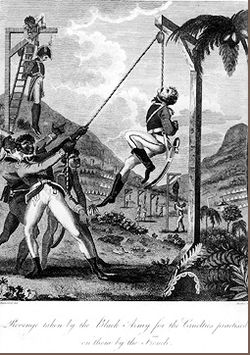
Haitians Hang French Troops For Their Acts of Cruelty

During the earthquake crisis in Haiti I have continued to ask the same question of my friends: How, in the 21st Century, can a country so close to the richest nation on earth be so poor?  No one seems to have an answer except for Pat Robertson (who is not a friend, by the way) who suggests that the Haitians made a pact with the devil when they made the French leave.  Seems an odd way to refer to a successful uprising against slavery, doesn’t it?

Since the earthquake, I have learned that Haiti was apparently the location of the world’s first successful uprising against slavery.  They fought the French and won.  It is also the world’s oldest black republic.  It is this achievement that a person like televangelist Pat Robertson suggests is a pact with the devil.

But now it seems that U.S. corporations are using Haitian workers in sweatshop factories to manufacture goods at wages of approximately 30 cents per hour.  That must be why the tiny nation is too poor to build things that can withstand earthquakes.  It will be useful to learn how many of these factories or sweatshops/slave camps have collapsed in the earthquake.  I would imagine that there will be some investigation of such places in the near future.  Perhaps the slave trade never really ended at all, but simply changed its name to ‘cheap labor’ or ‘sweatshop’ or ‘globalism.’

Here’s a history of Haiti from Wikipedia.

Here’s an article about the U.S. role in keeping Haiti poor.

Disney has used cheap labor in Haiti.  They say so themselves right here.

I particularly like their response to a question about child labor:

Q. What is your policy on child labor?
A.
Our Code of Conduct for Manufacturers prohibits child labor. Companies that make Disney-branded products must sign a contract stating that they do not and will not use child labor. Child is defined as “a person younger than 15 (or 14 where local law allows) or, if higher, the local legal minimum age for employment or the age for completing compulsory education.” If child labor is discovered in a factory, we generally seek to work with the factory, as well as the licensee that uses the factory, to identify the most feasible solution to remedy the situation as quickly as possible. This may include collaboration with government, multilateral institutions, NGOs or other companies that use the factory.

So Disney will ‘seek to work with the factory’ if it finds child labor going on. Am I the only one who’s shocked that a U.S. corporation would print such a statement of its own accord?  Because if it were me finding out about child labor, I would ‘seek to work’ a hammer into someone’s head.  For my part, I can only define very cheap labor in a very poor country where workers are threatened with reprisals if they try to improve their lot as slavery.  In fact, the more I learn about Haiti the less it looks like a country and more like a camp.

Google App to Help Find Information on People Missing in Haiti

This is an application from Google that tries to locate information about missing persons in Haiti. I don’t know how well it works, but I think Google is trying pretty hard with its considerable resources to find any data that might help.

Update (1-17-2010): News organizations that have set up sites to help locate people are apparently opening their systems and sharing their data with the Google people-finder application.  The MIT Center for Future Civic Media is calling on all people-finder data collectors to pool their data in one place.  This is very smart and will drastically increase the effectiveness of the Google people-finder app.  Here’s more about the call for shared data.