Artist Dave Gibbons did a video workshop revealing how he paints the Watchmen character Rorschach using digital tools. The video was produced for ImagineFX magazine which is dedicated to fantasy, sci-fi, comic and manga artists.

Artist Dave Gibbons did a video workshop revealing how he paints the Watchmen character Rorschach using digital tools. The video was produced for ImagineFX magazine which is dedicated to fantasy, sci-fi, comic and manga artists.
Here’s the trailer for the upcoming Where the Wild Things Are movie, directed by Spike Jonze. The movie is an adaptation of Maurice Sendak’s classic children’s story. Max, a disobedient little boy is sent to bed without his supper. He then creates his own world filled with creatures that make Max their king.

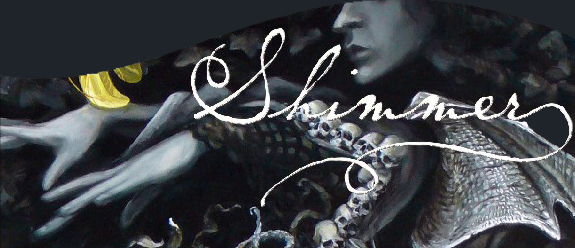 Shimmer is a magazine of contemporary speculative fiction. Kind of a fantasy/sci-fi sort of thing. They are offering their latest issue with 12 stories in it as a free download. Some of the titles included are, The Carnivale of Abandoned Tales, Jaguar Woman, Counting Down to the End of the Universe, and an author interview.
Download the latest issue of Shimmer Magazine.

Kutiman posts video mashups on YouTube that make brand new music. He takes video clips that other people have uploaded and he cuts pieces out of the people playing their instruments and then edits them all together with just the right timing and layering to create a whole new musical mix. This one’s a nice little funk number and the filmmaker/musician creates a lively atmosphere out of his found musical clips.

 In China, there’s a revolution in online novels. Writers are uploading their books to be read by millions of Chinese readers who pay a small amount for each book. The leading company offering online novels in China is Shanda Literature. Their site, Qidian.com, is the most popular destination for novel readers. Even regular bookstores are now offering print versions of online novels. Apparently, the online universe is China is relatively free of censorship and authors find themselves with more freedom to criticize.
Here’s a CNN article about the online publishing boom in China.

Here’s an absolutely fascinating film shot from the front of a streetcar in Barcelona, Spain. Look at the way the people in the city of 1908 run along with the streetcar trying to see and be seen by the camera. They seem to be full of joy and excitement. They run along and ride bikes and wave. Can you imagine people acting this openly today? There’s something profound in this little film. It just goes on along the tracks and through the crowds of happy onlookers without trying to make a point of any kind, but it makes a strong impression. Wonderful film. Watch it through to the end. It will make you feel inexplicably happy.

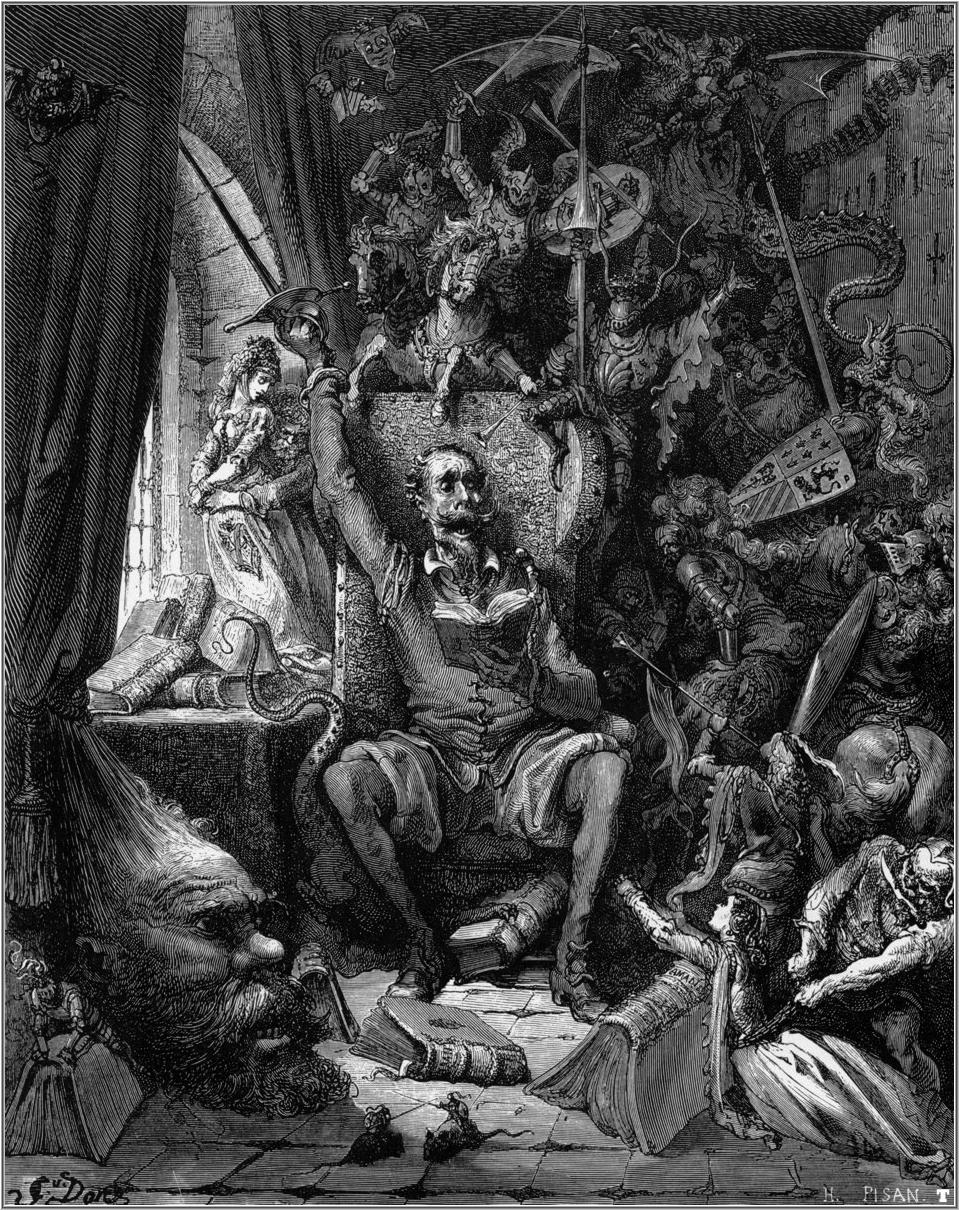 Here’s an illustration from Miguel de Cervantes’ novel, Don Quixote. It was done by Gustave Doré. It shows Don Quixote reading a book of chivalry in his library. I love the way Doré shows all the madness of Quixote’s imagination surrounding him in his chair as if his imagination and the book were coming to life. It’s a reminder that the sanest guy in the entire novel is really the Don himself… even though he does go off tilting at windmills as if they were giant monsters.
Click the image to enlarge.

Enjoy the terrors of these classic old-time radio horror productions. These are some of the tales that people used to spend their evenings listening to back in the 1930s and 40s. What a treat for a stormy night! You’ll stay up very late listening to these frightening dramas.
We’ve got stories from ‘Frankenstein’ to Edgar Allen Poe’s ‘The Pit and the Pendulum’ to Orson Welles’ original ‘War of the Worlds’ broadcast.
These incredible stories feature the voices of Boris Karloff, Peter Lorre, Agnes Moorehead, Basil Rathbone, Barbara Stanwyck, Ray Milland, Vincent Price, and Orson Welles.
Have a fantastic listen!

 What Do We Do Now?
It’s happening.
The earth is getting warmer.
The world’s scientists agree on it.
What does it mean?
What can we do?
When do we start?
It’s Happening
The majority of scientists worldwide agree that the earth is warming up and that human activities are making it worse. The United Nations recently released a report by a group of the world’s leading scientists and it paints a bleak picture of global warming. It states that we are in the midst of a worldwide crisis and that mankind must do something about it immediately or face certain disaster. It’s very simple. You either trust the scientists or you don’t. Candlelight Stories trusts the scientists. They have done the research and studied the evidence. Their data looks at a time period covering thousands of years and leads them to the conclusion that mankind is polluting the atmosphere so badly that the earth’s temperature is rising quickly.
 Build your own robot and hear it talk.
 Help Gepetto make Pinocchio. Then take the adventurous puppet to meet characters who ask him some tough questions.
 You’re a dwarf from ‘Snow White’ and you’re in the diamond mine trying to hit as many diamonds as you can while your energy lasts.
 Get Jack up the beanstalks to grab the gold coins. Watch out, because the giant is throwing things. If you’re good enough, you can play level 2.
translated and illustrated by Vaibhav Kodikal (Mumbai, India)
This illustrated story is one of the most wonderful things we ever received at Candlelight Stories. It was sent to us back in 1997 by a young man named Vaibhav Kodikal from Mumbai, India. This was one of his first illustration projects, finished while he was still in school. The Times of India did an article about how he made this story and published it on Candlelight Stories. He was and remains one of our very favorite artists. We hope he is doing very well indeed today.
The Panchatantra – The Brahmin’s Tale is from the oldest extant collection of fables in Sanskrit literature. Dating from the 4th century AD, it is based on still earlier collections of folk tales. The Panchatantra is sometimes attributed to an Indian sage, Bidpai (flourished about 300 A.D.). The tales, primarily about animals, are organized into five books on such topics as winning friends, losing property and waging war. They were originally intended to instruct a young prince in the conduct that would ensure his worldly success.
The Tale Begins
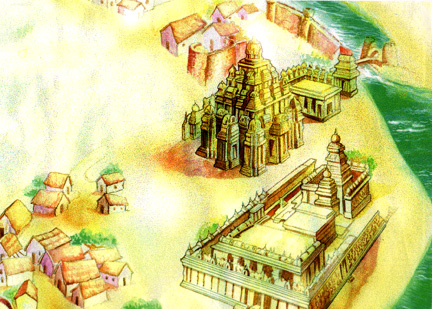
Long, long ago there was a poor Brahmin named Krishnan. He could not find enough work to do. Sometimes, he and his family had to go without food.

The Arabian Nights have inspired writers, poets, composers and painters in the West.
In 1882, Robert Louis Stevenson, the author of ‘Treasure Island,’ wrote:
‘There is one book, for example, more generally loved than Shakespeare, that captivates in childhood, and still delights in age – I mean the ARABIAN NIGHTS – where you shall look in vain for moral or for intellectual interest. No human face or voice greets us among that wooden crowd of kings and genies, sorcerers and beggarmen. Adventure, on the most naked terms, furnishes forth the entertainment and is found enough.’