In the country of Zouman, in Persia, there lived a Greek king. This king was a leper, and all his doctors had been unable to cure him, when a very clever physician came to his court.
He was very learned in all languages, and knew a great deal about herbs and medicines.
As soon as he was told of the king’s illness he put on his best robe and presented himself before the king. “Sire,” said he, “I know that no physician has been able to cure your majesty, but if you will follow my instructions, I will promise to cure you without any medicines or outward application.”
Sire, there was once upon a time a fisherman so old and so poor that he could scarcely manage to support his wife and three children. He went every day to fish very early, and each day he made a rule not to throw his nets more than four times. He started out one morning by moonlight and came to the sea-shore. He undressed and threw his nets, and as he was drawing them towards the bank he felt a great weight. He though he had caught a large fish, and he felt very pleased. But a moment afterwards, seeing that instead of a fish he only had in his nets the carcase of an ass, he was much disappointed.
Great prince of the genii, you must know that we are three brothers– these two black dogs and myself. Our father died, leaving us each a thousand sequins. With this sum we all three took up the same profession, and became merchants. A short time after we had opened our shops, my eldest brother, one of these two dogs, resolved to travel in foreign countries for the sake of merchandise. With this intention he sold all he had and bought merchandise suitable to the voyages he was about to make. He set out, and was away a whole year. At the end of this time a beggar came to my shop. “Good-day,” I said. “Good-day,” he answered; “is it possible that you do not recognise me?” Then I looked at him closely and saw he was my brother. I made him come into my house, and asked him how he had fared in his enterprise.
I am now going to begin my story (said the old man), so please attend.
This hind that you see with me is my wife. We have no children of our own, therefore I adopted the son of a favorite slave, and determined to make him my heir.
My wife, however, took a great dislike to both mother and child, which she concealed from me till too late. When my adopted son was about ten years old I was obliged to go on a journey. Before I went I entrusted to my wife’s keeping both the mother and child, and begged her to take care of them during my absence, which lasted a whole year. During this time she studied magic in order to carry out her wicked scheme. When she had learnt enough she took my son into a distant place and changed him into a calf. Then she gave him to my steward, and told him to look after a calf she had bought. She also changed the slave into a cow, which she sent to my steward.
Sire, there was once upon a time a merchant who possessed great wealth, in land and merchandise, as well as in ready money. He was obliged from time to time to take journeys to arrange his affairs. One day, having to go a long way from home, he mounted his horse, taking with him a small wallet in which he had put a few biscuits and dates, because he had to pass through the desert where no food was to be got. He arrived without any mishap, and, having finished his business, set out on his return. On the fourth day of his journey, the heat of the sun being very great, he turned out of his road to rest under some trees. He found at the foot of a large walnut-tree a fountain of clear and running water. He dismounted, fastened his horse to a branch of the tree, and sat by the fountain, after having taken from his wallet some of his dates and biscuits. When he had finished this frugal mean he washed his face and hands in the fountain.
In the chronicles of the ancient dynasty of the Sassanidae, who reigned for about four hundred years, from Persia to the borders of China, beyond the great river Ganges itself, we read the praises of one of the kings of this race, who was said to be the best monarch of his time. His subjects loved him, and his neighbors feared him, and when he died he left his kingdom in a more prosperous and powerful condition than any king had done before him.
The stories in the Fairy Books have generally been such as old women in country places tell to their grandchildren. Nobody knows how old they are, or who told them first. The children of Ham, Shem and Japhet may have listened to them in the Ark, on wet days. Hector’s little boy may have heard them in Troy Town, for it is certain that Homer knew them, and that some of them were written down in Egypt about the time of Moses.
‘Snow White and the Seven Dwarfs’ is possibly the greatest fairy tale of them all from the Brothers Grimm. In this full 30-minute production you will hear a cast of characters, completely original orchestral music, songs, and fantastic sound effects. We tell the story in a way that is unlike any you have heard before. When we made this audio story we worked very hard for months to get it right. We made it as carefully as we would make a film. The entire production is cinematic in its scope and we think it is the most exciting story we have ever done. So turn off every distraction, dim the lights, and enjoy thirty minutes of incredible adventure.
We’d love to hear your comments and reviews of this production. Feel free to send your feedback.
In addition to listening, you can also read our complete original script for the production.
This story was written in 1904, by Laurence Housman. He was from England and wrote many stories, novels and plays. This story first appeared in a book of stories called The Blue Moon.
A Chinese Fairytale tells of the young Tiki-pu who wants desperately to learn how to paint. But he is only a servant and must resort to trickery in order to learn his craft.
This is the story of young Momotaro, whose name literally means Peach Boy. The story is one of the most popular from Japanese folklore. Its theme of the unification of a people separated by hostility into an effective force for change resonates throughout history and applies to many different cultures.
More of our larger audio productions with music and sound effects can be purchased by joining our Sound Story Club for just $9.95 a year.
This is a story from the collection of the Brothers Grimm. It concerns three brothers, one of whom is a simpleton. When this simpleton finds a golden goose opportunities and complications seem to meet him at every turn.
The illustration is by Leslie Brooke and is from a 1905 book entitled, ‘The Golden Goose Book.’
More of our larger audio productions with music and sound effects can be purchased by joining our Sound Story Club for just $9.95 a year.
Welcome to our first free audio podcast of great fairy tales and children’s stories. Each week, you’ll find fantastic bedtime stories that you can listen to right here on our blog or download to play later. Feel free to burn personal CDs of your stories for home use or on those long car trips that require lots of entertainment!
We begin with a children’s favorite, The Three Little Pigs. It’s a tale that thrills almost all young children and you can’t go wrong with this one. We’ve created an easy-to-understand version of the story that’s both exciting and amusing.
We’ll continue to post stories often so that you always have a great source of bedtime stories or tales to take with you on an iPod or a car trip.
More of our larger productions like Snow White can be purchased by joining our Sound Story Club for just $9.95 a year.
Tom Thumb is a tale by the Brothers Grimm who, in the 1800s, collected tales that were popular in Europe as part of their study of the German language. Their collection became world-famous and has influenced children’s literature ever since. Little Tom is one of the most famous characters in fairy tales. Enjoy his adventures. We’ll post another story about this clever little person soon.
by Artie Knapp (USA)
Illustrations by Barbara Leonard Gibson
Popular children’s book author Artie Knapp hits the book stores with his latest offering, ‘Stuttering Stan Takes a Stand.’
Stanley is like most squirrels: he loves nuts, climbing trees and playing with friends. But Stanley feels different from the other animals in his neighborhood, because he has a problem with words. Teased and bullied about his stuttering, Stanley refuses to let on that his feelings are being hurt, until one day he learns an important lesson from a new friend.
by Artie Knapp (USA)
the author has an excellent story site: Knapptime Stories
A mouse in the grass ran about,
Stopping by the water spout.
Nibbling on something I could barely see,
And didn’t seem to notice me. Continue reading …
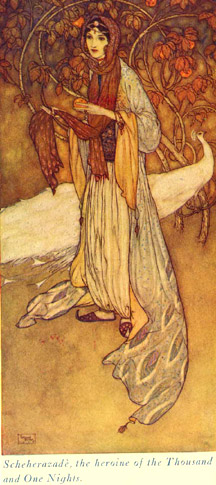 In the chronicles of the ancient dynasty of the Sassanidae, who reigned for about four hundred years, from Persia to the borders of China, beyond the great river Ganges itself, we read the praises of one of the kings of this race, who was said to be the best monarch of his time. His subjects loved him, and his neighbors feared him, and when he died he left his kingdom in a more prosperous and powerful condition than any king had done before him.
 This story is read by Laral Andrews.
 This story is read by Alessandro Cima.
 Welcome to our first free audio podcast of great fairy tales and children’s stories. Each week, you’ll find fantastic bedtime stories that you can listen to right here on our blog or download to play later. Feel free to burn personal CDs of your stories for home use or on those long car trips that require lots of entertainment!