There was once a girl who was idle and would not spin, and let her mother say what she would, she could not bring her to it. At last the mother was once so overcome with anger and impatience, that she beat her, on which the girl began to weep loudly. Now at this very moment the Queen drove by, and when she heard the weeping she stopped her carriage, went into the house and asked the mother why she was beating her daughter so that the cries could be heard out on the road?
Monthly Archives: April 2009
Grimms’ Fairy Tales: The Three Little Men in the Forest
There was once a man whose wife died, and a woman whose husband died, and the man had a daughter, and the woman also had a daughter. The girls were acquainted with each other, and went out walking together, and afterwards came to the woman in her house. Then said she to the man’s daughter, “Listen, tell thy father that I would like to marry him, and then thou shalt wash thyself in milk every morning, and drink wine, but my own daughter shall wash herself in water and drink water.”
Grimms’ Fairy Tales: Rapunzel
There were once a man and a woman who had long in vain wished for a child. At length the woman hoped that God was about to grant her desire. These people had a little window at the back of their house from which a splendid garden could be seen, which was full of the most beautiful flowers and herbs. It was, however, surrounded by a high wall, and no one dared to go into it because it belonged to an enchantress, who had great power and was dreaded by all the world.
Grimms’ Fairy Tales: Little Brother and Little Sister
Little brother took his little sister by the hand and said, “Since our mother died we have had no happiness; our step-mother beats us every day, and if we come near her she kicks us away with her foot. Our meals are the hard crusts of bread that are left over; and the little dog under the table is better off, for she often throws it a nice bit. May Heaven pity us. If our mother only knew! Come, we will go forth together into the wide world.”
Grimms’ Fairy Tales: The Pack of Ragamuffins
The cock once said to the hen, “It is now the time when our nuts are ripe, so let us go to the hill together and for once eat our fill before the squirrel takes them all away.” “Yes,” replied the hen, “come, we will have some pleasure together.” Then they went away to the hill, and on it was a bright day they stayed till evening.
Grimms’ Fairy Tales: The Twelve Brothers
There were once on a time a king and a queen who lived happily together and had twelve children, but they were all boys. Then said the King to his wife, “If the thirteenth child which thou art about to bring into the world, is a girl, the twelve boys shall die, in order that her possessions may be great, and that the kingdom may fall to her alone.” He caused likewise twelve coffins to be made, which were already filled with shavings, and in each lay the little pillow for the dead, and he had them taken into a locked-up room, and then he gave the Queen the key of it, and bade her not to speak of this to any one.
Grimms’ Fairy Tales: The Wonderful Musician
There was once a wonderful musician, who went quite alone through a forest and thought of all manner of things, and when nothing was left for him to think about, he said to himself, “Time is beginning to pass heavily with me here in the forest, I will fetch hither a good companion for myself.” Then he took his fiddle from his back, and played so that it echoed through the trees. It was not long before a wolf came trotting through the thicket towards him.
Grimms’ Fairy Tales: The Good Bargain
A Special Note About This Story:
This story is one of several examples of bigotry in the Grimms’ collection of stories. The outrageous bigotry on display in the story is a frightening example of how long hatred against Jewish people had existed in the parts of Germany where this tale was told.
While it contains prejudice and absolutely calls into question the entire collective work of the Brothers Grimm, it is a story that should be understood and studied in the interests of keeping the historical record accurate. It is also worth studying the possible influence of stories like this one on the entire tradition of Western fairy tales. To think that this sort of thing is purely historical in nature is a mistake.
Grimms’ Fairy Tales: Faithful John
There was once on a time an old king who was ill, and thought to himself, “I am lying on what must be my death-bed.” Then said he, ” Tell Faithful John to come to me.” Faithful John was his favourite servant, and was so called, because he had for his whole life long been so true to him. When therefore he came beside the bed, the King said to him, “Most faithful John, I feel my end approaching, and have no anxiety except about my son. He is still of tender age, and cannot always know how to guide himself.
Grimms’ Fairy Tales: The Wolf and the Seven Little Kids
There was once upon a time an old goat who had seven little kids, and loved them with all the love of a mother for her children. One day she wanted to go into the forest and fetch some food. So she called all seven to her and said, “Dear children, I have to go into the forest, be on your guard against the wolf; if he come in, he will devour you all — skin, hair, and all. The wretch often disguises himself, but you will know him at once by his rough voice and his black feet.” The kids said, “Dear mother, we will take good care of ourselves; you may go away without any anxiety.” Then the old one bleated, and went on her way with an easy mind.
What’s in the Box?: Brilliant Sci-Fi Short
This is a very mysterious short film by a YouTube user called Timacious. It’s connected with a website that appears to be some kind of puzzle. I have no idea what’s going on here, but I loved watching the film. The first-person point of view works so well that it may in fact be the best first-person film I’ve ever seen. The chase is brilliantly staged and the locations are totally convincing. It seems like something’s gone out of control at a lab and there’s some sort of time warp or black hole opening up above the city. The character is being pursued by people with gas masks and hazmat suits. He’s also got some bizarre magic box that appears to send energy out toward the disturbance in the sky.
Totally brilliant little film. I want more.

Authors Guild Attacks Reading Out Loud
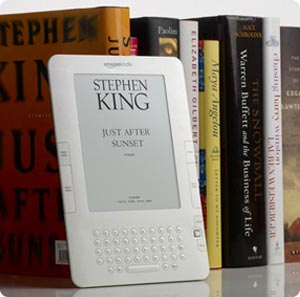 In what amounts to a shocking display of callous disregard for handicapped readers, The Authors Guild threatened to sue Amazon.com over its text-to-audio feature built into the Kindle 2.0 ebook reader. It then negotiated with Amazon to allow authors to disable the feature for their books.
Apparently, the Guild and its member authors (who really need to have their names listed in public) have decided that the Kindle feature violates some mysterious copyright related to audio book rights. So the logic they use seems to suggest that if I worked in my garage to invent an optical reader that would read my own books aloud to me as I passed it over the pages, I would be somehow violating an author’s copyright. This is absurd.
The Reading Rights Coalition organized a protest in New York City a couple days ago to urge authors to allow everyone access to ebooks.
Read this amazing double-talk response to the protests from the Guild in which it pretends to have concern for handicapped readers. They keep insisting that a device that reads a book out loud is an audio book. No, dear Authors Guild, it is not. It is a device that reads books out loud. Like I do when I read to my wife. What if a very life-like robot walked around reading a book to itself out loud. Would that be an ‘audio book?’ Publishing companies are free to produce their own audio books and sell them and make contracts for them. But they cannot tell people not to build machines that read. Forget it.
The Authors Guild is mounting an attack on handicapped readers all over the world and should be made to look like the dinosaur it really is. Which authors are a part of this assault on the blind? Candlelight Stories wants the list. We’ll happily publish it. We’ll call the list, ‘Authors Who Don’t Want Blind People to Read.’

Bob Dylan Walks with Ghosts
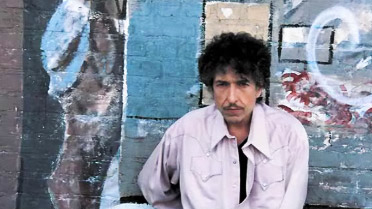 Bill Flanagan at Times Online has an interview with Bob Dylan. They talk about Dylan’s impressions of Barack Obama’s writing in Dreams of My Father. It seems that Dylan considers the president to be a pretty good writer, capable of making readers think and feel at the same time. He thinks Obama says some ‘profoundly outrageous things.’ I always enjoy the slightly argumentative way Bob Dylan answers questions. So often, when an interviewer thinks something is obvious, Dylan says, ‘not exactly,’ and goes on to carefully explain how the interviewer is wrong.
Dylan talks about ghosts in the American South:
It must be the Southern air. It’s filled with rambling ghosts and disturbed spirits. They’re all screaming and forlorning. It’s like they are caught in some weird web – some purgatory between heaven and hell and they can’t rest.
Then this:
BF: Are you a mystical person?
BD: Absolutely.
BF: Any thoughts about why?
BD: I think it’s the land. The streams, the forests, the vast emptiness. The land created me. I’m wild and lonesome. Even as I travel the cities, I‘m more at home in the vacant lots. But I have a love for humankind, a love of truth, and a love of justice. I think I have a dualistic nature. I’m more of an adventurous type than a relationship type.
BF: But the album is all about love – love found, love lost, love remembered, love denied.
BD: Inspiration is hard to come by. You have to take it where you find it.
Anyone who talks that way is definitely going to be able to sell me some music. I will be all ears and I will walk around for months trying to find those ghosts. If he says they’re there, then they are.

Is Poetry Dead Just In Time for National Poetry Month?
 Well goodness! Newsweek as seen fit, just as National Poetry Month was about to begin, to announce the possibility that poetry has completely and totally kicked the proverbial country bucket. Could this really be? If no one is reading poetry, can it still be a living thing? Apparently, the National Endowment for the Arts released a report titled Reading on the Rise. Sounds optimistic. But they mean fiction. Not poetry. Readership for poetry has declined to its lowest point in 16 years. Everybody is worried. Nobody knows what to do. I suggest doing nothing. Enjoy National Poetry Month because it’s kind of fun to see unpopular poets stand up and try to be famous. Read some popular poems if you haven’t already and just remember that poetry really is very hard to understand. I think that’s the key to the whole thing. It’s a huge pain to read. There’s all these words sometimes rhyming, sometimes not. I can never tell what the poet is talking about and I get annoyed. It’s not like Twilight at all. Although some really good poems do have vampires in them.
But then, perhaps a week later – maybe a year. I’ll be walking along looking for a good plate of hotwings, and I’ll stop and think to myself, ‘Oh right! That’s what that lady meant by that weird line in her poem. Very cool.’
That’s why I like poetry. It hits you when it hits you and that’s all that matters.
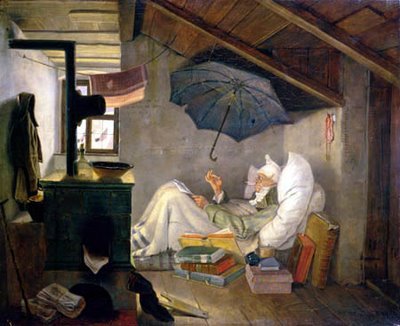
The painting is by poet/painter, Carl Spitzweg. It’s called The Poor Poet. It’s from 1835 and appears to show one of these poets taking the easy way out as he concocts a nearly indecipherable verse. That umbrella is either magically floating or it’s caught in some serious cobwebs.

Ebooks are a Gradual Change for Publishing
At the Conversational Reading blog, Scott Esposito writes a post called ‘Why EBooks will Change How the Industry Functions.’ He’s writing about his reaction to another blogger who wrote a post about ‘Why Ebooks Must Fail.’ I like Esposito’s common sense approach to the subject of ebooks and his confidence that the publishing industry will gradually adapt to them and incorporate them in its business model:
…as I’ve come to understand the ebook format better and better, I’ve come to believe that it represents more than just a different way of reading. I’m beginning to see that it represents new modes of relations between authors, publishers, and readers, new concepts of books as a commodity, and new concepts of copyright.
I agree. After all, it’s just words. It really doesn’t matter how you get them into your head. I enjoy reading some books off my iPod. Other books I prefer to read in hardback. Detective novels I always prefer as paperbacks. Deciding that the book publishing industry is doomed because of ebooks is just ridiculous.
