
Photo: Why a Green Bottle?

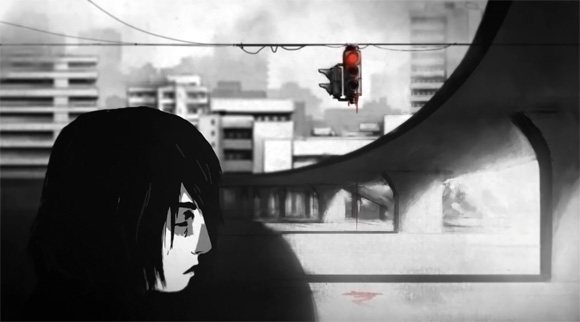
This is an animation by Anders Friis Christiansen, Martin Sand Vallespir, Kirsten R. Grann, Michael Nielsen, Astrid M. Lauridsen, and Rikke Skovgaard of the Animation Workshop in Denmark. A young girl loses her father in a war-torn city after an accident with a cluster bomb.
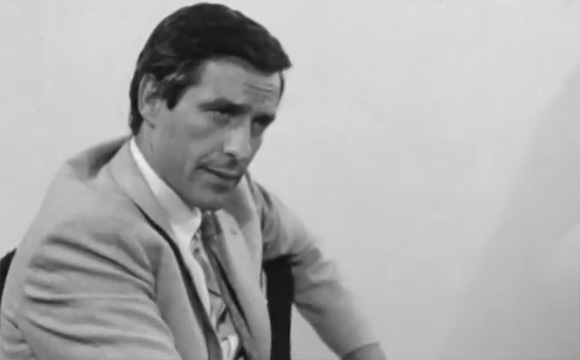
John Cassavetes’ first film was called ‘Shadows.’ It was made in 1959 and I think it might be the greatest film about race in America that’s ever been made. Cassavetes has always struck me as having an element of that required con-man aspect of the personality that is present in many good actors. When he talks he seems impressed with what he is saying and he knows how to deliver it with just the right amount of humor and a few self-deprecating remarks. But he means every goddamn word of it and he puts all of his thoughts into his film works. He’s one of those rare objects of confusion that sometimes crop up in American art. I’ve been watching a bunch of his films lately and I don’t think I’ve ever seen a filmmaker so interested in looking at the inability of the American adult to understand or even perceive the meaning of their habitual mannerisms. For me, his films illuminate what it means to be a grownup and how the performance required of grownups contrasts with what they really want to be.
Cassavetes on making ‘Shadows:’
That people can go out with nothing and through their own will and through their determination make something that exists… out of nothing. Out of no technical know-how, no equipment. There wasn’t one technician on the entire film. There wasn’t anybody who knew how to run a camera… walked in and started to read the directions of how to reload it. Got a Movieola and looked at it. Did all the things in the world and we made eight million mistakes. But it was exciting and fun.
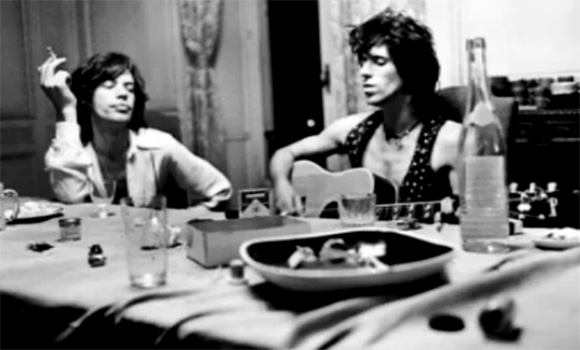
This is a 1968 French documentary that was probably shot just after or during the making of his great marriage disaster film, ‘Faces.’
 By Quenby Eisenacher
The road doesn’t run in a straight line, splitting the vast plain in half. It curves back and forth, winding around nothing, a ribbon of hard-packed dirt and stones that meanders toward the silvery haze of the horizon. There’s a cloud of dust thrown up behind the bus, the rear windows already coated with a layer of grime that even the daylight can’t penetrate. Every few minutes, one of the larger stones gets chucked up into the undercarriage, striking hard and fast, the sound too much like a gunshot. A few of the children wince at the noise, their eyes squeezing shut, scuffed skin pulled taut over their white knuckles. Karin glances at the boy beside her, the one with the mud caked into the ends of his straw-colored hair. She could speak to him, she thinks, just a few words to show that she doesn’t want to be a stranger. But the words fail to come, her tongue clinging to the roof of her mouth, swollen and thick, as if she’s forgotten how to make it work.
Over another bump and she closes her eyes, her toes curling inside the stiff brown shoes on her feet. Swinging her right leg, she taps the seat in front of her with the tip of her cracked toe, the edge of  her blue sock just visible where the upper pulls away from the sole. The head in front of her doesn’t turn, black braids neatly parted and tied up at the bottom with little bits of red ribbon. Karin looks at the ribbon for a moment, at the dull film of dust hiding the shine of satin from view. Her eyes are still fixed on the vivid strips of cloth as her fingers find her own hair, loose and scraggly around her shoulders. She wishes she had ribbon like that, and swings her foot into the back of the seat one more time.
The window is on the other side of her, close enough that she can press her left shoulder against the glass and silence the rattle inside the frame. There’s not as much dust either, being only a few seats back from the driver. For a moment, she feels bad for the children in the rear, the ones next to the filthy windows, cut off from the light and the scenery trundling past them on all sides. Not that there’s much to see, but it’s better than staring at the floor. Crossing her arms until her hands are hidden inside her sleeves, she leans back, her chin tucking into her shoulder, one dirty lock of hair sliding out from behind her ear as she fixes her gaze on some imaginary spot far off in the distance.
Continue reading


Swoon is a Belgian poet filmmaker who makes films that try to blur the boundary between written poem and moving image. He mixes his own footage with found footage and sometimes mixes his own words with others. I like the quiet easy tone of his work. I like his manipulation of imagery. His work is a very difficult kind of work because it tries to make something new from two different things. Poetry is a perfect form all by itself. But film is never satisfied. It’s always looking for something to include within it. So it’s natural for film to go looking for poetry and try to bring it in. But poetry resists all alliances. Poetry seems content and willing to wait for centuries. It requires nothing. It doesn’t care what film wants. It will sit on a dry page in some crowded shelf somewhere waiting six hundred years for just a single pair of eyes to come along in boredom, open to the page, glance in, read half-way down and then slap the book shut for another six hundred years until someone decides to finish reading the goddamn thing. That’s patience. Film doesn’t have that. Film must be seen now or it withers. It begins to rot. Even if it’s digital. Digital films become confused and get lost in the forest of other digits. They may never find their way out again. So working with the two things and trying to get them together is very difficult but may actually make perfect sense.
This is a film poem triptych that is Swoon’s first work to include his own words. There’s a site for the film with more information.
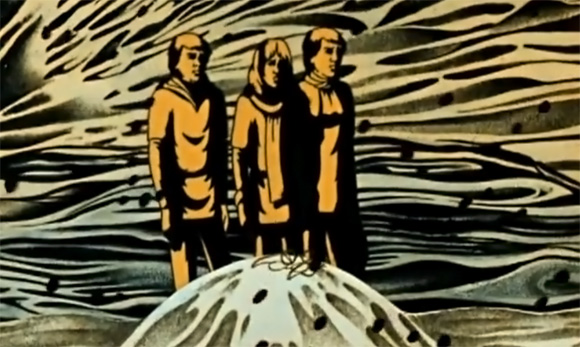
This film was directed by Vladimir Tarasov and was adapted from a novel by Kir Bulychev.
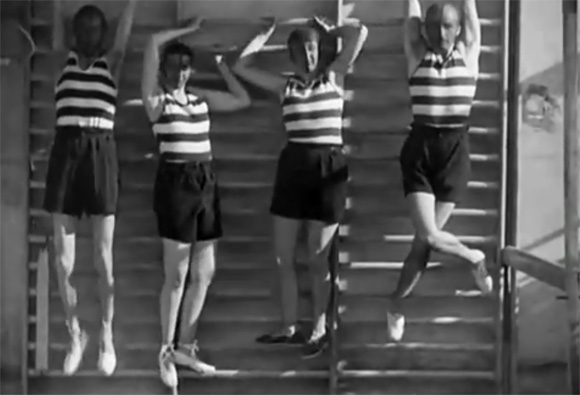
Surrealist art great, Man Ray, made this film in 1929. It follows a pair of indecisive travelers who base all their action on chance. They head out to a fabulous chateau in the hills and wander around inside and out. They run into four odd persons who enjoy swimming and running about as if the place is their private gym. But what is Man Ray doing here? Why all these shots of windows, lamps, sculptures? He is finding the abnormal in the normal. Wherever he happens to be with a camera he can make the surreal. He’s functioning as an artist, looking for odd angles, shadows, contrasts. He is also diving into the great current of his culture. The house is a castle filled with fine objects and great art. Man Ray is expressing his enthusiasm. This is an extremely childish film. I mean that as a compliment, though I really see nothing exceptional in works for children. But for an artist to function as a child for a certain amount of time is extraordinary and beneficial I think. But that kind of thinking must end and lead to its own destruction. In other words, I do not think any children’s author or illustrator should ever continue to work in that way for more than a few years. Then it is time to think about serious things and to make things that upset people. Perhaps that is my main criticism for most of the things I have seen by Man Ray. He seems a little bit too pleasant. I might be wrong about that. I have to look a little more.
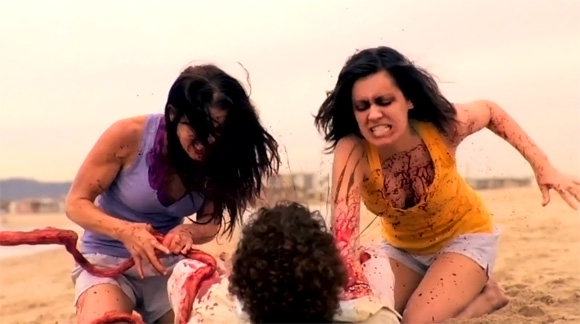
Director Palmer handles his equipment, crew and actors without letting the job overwhelm his natural instinct for telling a ripping good story and making us want to know what’s going to happen next. In fact, he made much of his own equipment, including a simple rig for filming underwater! He used water guns to shoot fake blood. I love that kind of filmmaking. And I love that he did it all without ridiculous shooting permits. He just hit the side streets with his little crew and turned the whole neighborhood into what I imagine was a hell of fun time. He has created a tight little view into a California suburb at Christmas time by littering the landscape with decorations that lend a sort of lunatic and false joy to the dark comedy and spurting blood.
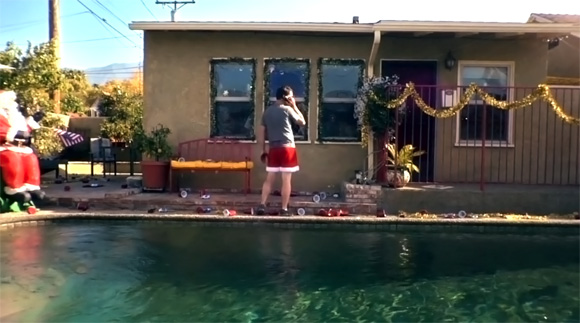
So the main character, played to intense and despairing perfection by Adam Conger, tries to get away from his attackers by lying low at a friend’s house. Conger really hits his role on the money. He’s perfect as the overwhelmed slacker-type dude who’s actually fairly driven and maniacal in survival mode. But he just can’t seem to find a good way to explain the desperate situation to his friend who is played with great comic ability by Tony Nunes. I believe that during the violent proceedings in his backyard, this friend is primarily engaged with heating up a HotPocket. Needless to say, the hero’s plan for lying low does not work out very well!
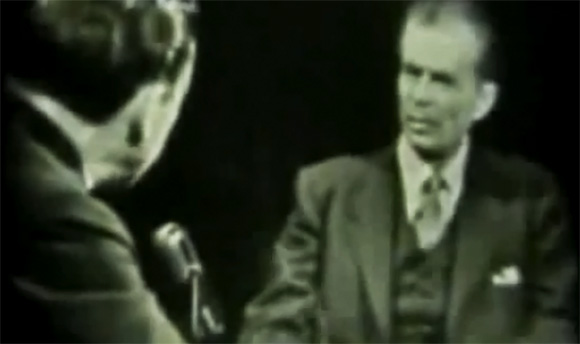
Wallace: …and we’ll be persuaded to vote for someone that we do not know we are being persuaded to vote for?
Huxley: Exactly, I mean this is the rather alarming feature… that you are being persuaded below the level of choice and reason.
Perhaps that explains the election of George W. Bush, a raging drunk without the slightest education – a psychopathic false cowboy with delusions of a holy mission to invade the Middle East. It was national suicide. The election of Bush was the worst thing to happen to the United States since the Civil War and it cannot be explained by logic. The world is only at the beginning of decades spent recovering from the criminality and death unleashed by Bush. I think Huxley might have said that Bush was the easily predictable outcome of uncontrolled corporatization. Every corporation likes to push dull-witted and unimportant people into middle management positions where they can function as the tiered facade standing between the board members and the Chinese slave camps.
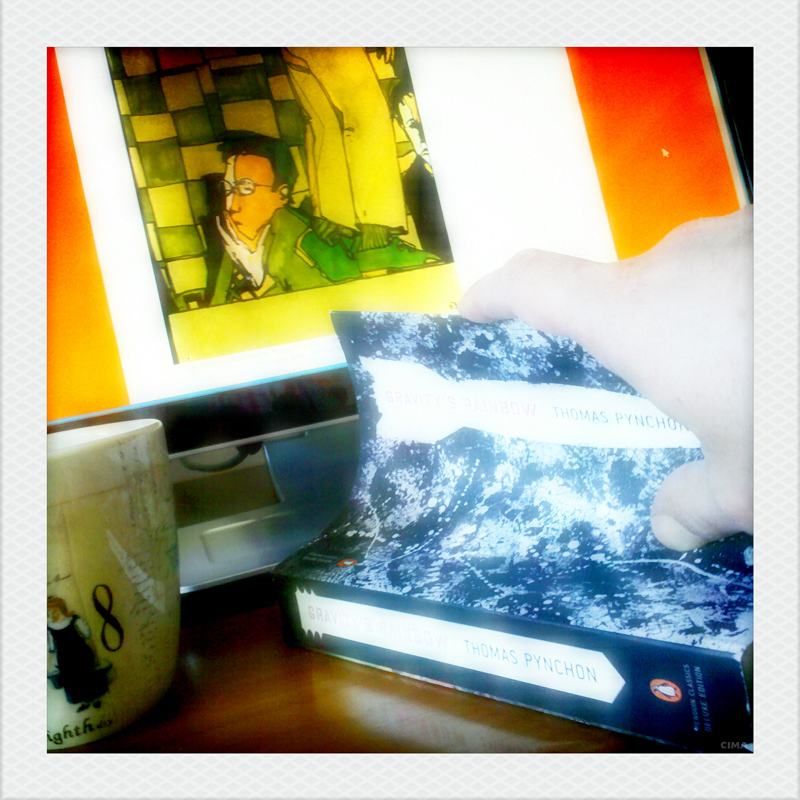 Every word in Thomas Pynchon’s deranged dance macabre, ‘Gravity’s Rainbow,’ seems, like HTML, to link out to some other subject. The book seems for me to exist in-between worlds, barely attached to this one while trying desperately to connect us with another fuzzily glimpsed, just-hinted, vague world, suggested by pure chance connections between ideas and events here on a fractured and demented earth. I’m barely one hundred and sixty-five pages into this book and I’m reacting for it and against it in nearly equal measure. It’s a goddamn blast. It’s also a motherfucking bitch. Every page of it so far mentions some kind of rocket trajectory, launch pad, descent, explosion or blast of light. Everyone in the book seems to be living out one debauchery or another while all the time expecting to be blown away in bits, perhaps even looking forward to it. Death, for Pynchon, seems on the surface like fun. The book almost makes a mockery of dark humor, of dying. It’s as if Pynchon wants to give the finger straight into the yawning mouth of death’s favorite century.
Things I notice so far about the book: Rockets of course. Everywhere and in every mind of the characters. It’s all about predicting bomb hits and finding the rockets. People want to understand how one of the characters can possibly manage to have sex in various locations just prior to those spots being bombed into oblivion by German V-2 rockets. The books seethes with sexual excitement that’s a death-wish. I also notice that Pynchon is associating Hansel & Gretel, the forest and the witch’s oven with Germany and the events of World War II. The Holocaust is looming over this book on every page. There are constant mentions of cause and effect, how it operates and whether it might be possible to break out of its logic. Can a rocket attack be sensed before it even hits? Psychological early warning system. Brain radar. Statistical analysis for making predictions.
Imagine a missile one hears approaching only after it explodes. The reversal! A piece of time neatly snipped out…a few feet of film run backwards…the blast of the rocket, fallen faster than sound–then growing out of it the roar of its own fall, catching up to what’s already death and burning…a ghost in the sky…
Quite a few references to film in this book so far up to page one hundred and sixty-five.
What could be more paranoid than a constant worry about bomb rockets? The book seems like a grotesque exaggeration at first. But that’s the joke I think. It’s actually an understatement and proves paranoia to be the most well-placed and logical mental operation in a century during which people were dug into trenches and told to march toward each other like polite firing squads. A century in which men marched millions of people into gas chambers and pushed them through ovens. A century in which entire cities were blown off the face of the planet while the citizens were out shopping for groceries. Pynchon seems like an author who is not afraid of any of it. He’s like a guy laughing at the scene of a traffic accident. Or photographing it like Warhol did. And the book’s laugh-in-a-sort-of-half-shocked-way funny. Here’s a bit from a funny scene where a guy visits a nurse he wants to sleep with but must endure a lengthy sit-down with an older woman patient who wants to share her candy:
Under its tamarind glaze, the Mills bomb turns out to be luscious pepsin-flavored nougat, chock-full of tangy candied cubeb berries, and a chewy camphor-gum center. It is unspeakably awful. Slothrop’s head begins to reel with camphor fumes, his eyes are running, his tongue’s a hopeless holocaust. Cubeb? He used to smoke that stuff. “Poisoned…” he is able to croak.
“Show a little backbone,” advises Mrs. Quoad.
“Yes,” Darlene through tongue-softened sheets of caramel, “don’t you know there’s a war on? Here now love, open your mouth?”
It’s funny, no? But it should also set off sparks off recognition in your head that link up with gas chambers. You just can’t trust Pynchon to be genuinely funny. He’s watching you laugh and getting ready to slit your careless throat. No wonder Pynchon uses a secret identity. He’s dangerous. He seems slightly criminal. This guy loves conspiracies. He must have some really excellent ideas about who killed Kennedy. I mean he’d probably say Oswald did it, but it’s why Oswald thought he was doing that makes it interesting.
I love it when authors hide their identities. Pynchon has been effectively doing this for about fifty years now. This reminds me, as all secret identities do, of Batman.
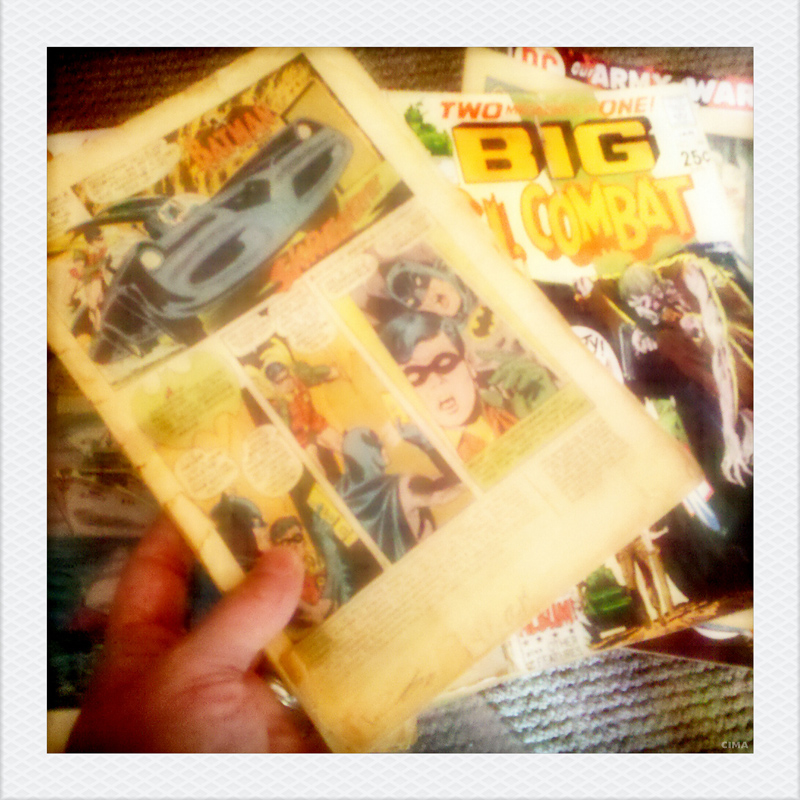 Here’s my ancient and torn copy of a Batman giant issue from 1969. Down in the lower margin there I wrote ‘fuck.’ I’m not sure why I would have done something so charming to a Batman comic. I must have been practicing my favorite words or something. What does an old comic book have to do with Pynchon? I don’t really know but it seems to fit. In fact, comic artist Frank Miller did the cover for the recent Penguin edition of Gravity’s Rainbow. That’s the copy of the book in the first photograph above. Behind the book in that photo is a computer screen showing a drawing by artist Zak Smith who did a thing he called ‘Illustrations for Each Page of Gravity’s Rainbow.’ It’s been shown at the Whitney Museum and you can buy it in book form.
It’s strange how much I’m enjoying this book because I hated ‘Ulysses’ by James Joyce. I think Pynchon snagged some stuff from Joyce. He even resorts to script format for some portions of the book the way Joyce did. But I only like the first part of Ulysses which takes place on top of a tower and has a character shaving. I also enjoy the part about Bloom in the park watching the girl’s underpants. But that book suggests to me that Joyce was mentally ill. With Pynchon I get the feeling that the world and everyone in it is mentally ill.
There’s also a definite connection between Pynchon and William S. Burroughs. In fact I wouldn’t be surprised if they were the same person. But that’s impossible. They both like secret organizations of scientists or researchers though. They share this fascination with science gone crazy and used to control minds – populations. But Pynchon is a better writer – less concerned with gimmicks. His language is a constant beauty which is the great antidote to his hilariously murderous world view. His entertaining and wildly connecting sentences indicate to me that Thomas Pynchon is an optimist. But, as with Joyce, I find myself constantly shutting the book and wondering, ‘How did he do it?’ How for fuck’s name did this guy not only maintain a secret identity but accumulate so much esoteric knowledge in the late sixties so as to be able to jam-pack every single sentence in the bloody book with some reference or other to some event or other that no sane person would ever have heard of in a lifetime? What the hell is going on in this man’s mind that allowed him to achieve Google knowledge density in 1973?
For all the good it might do anyone, I’ll keep reading the book and make a few more posts about it. I tend to relate work like Pynchon’s to my own video work. It’s something to do with the density of thought and imagery. It’s always good to read solid evidence of someone being crazier than you are so that you can get down and work at your own stuff with a little less embarrassment.